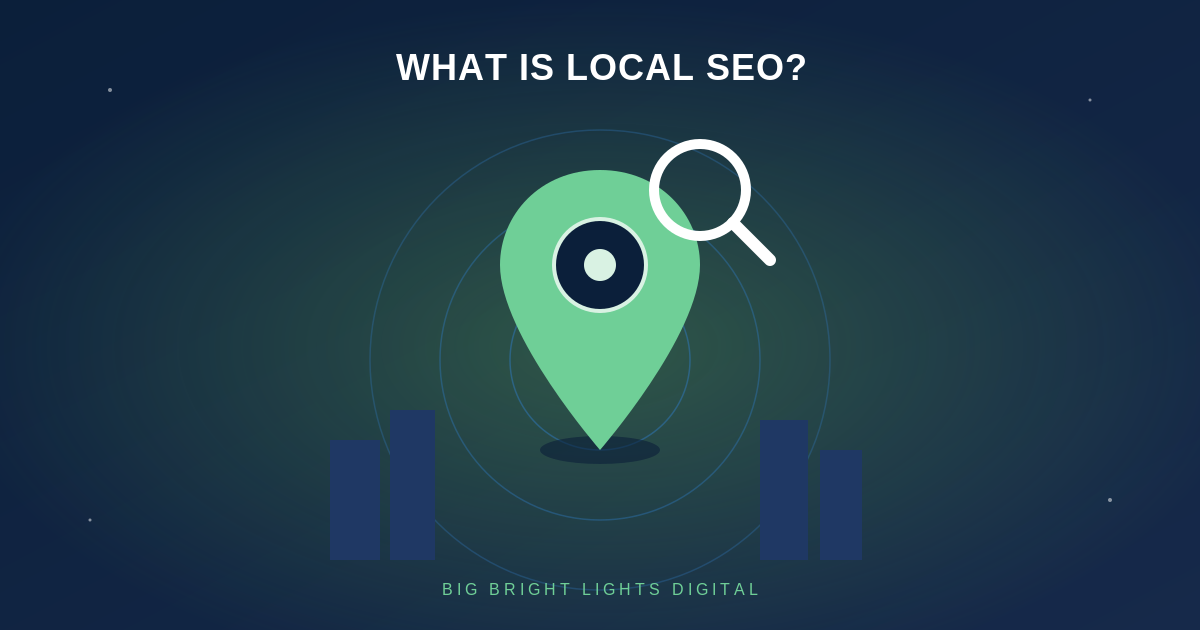
What Does "Local SEO" Actually Include? A Plain-English Breakdown "Local SEO" is one of those terms that gets used constantly and explained rarely. Most small business owners know they should probably be doing it. Fewer could tell you what it actually involves. Here's the plain-English version: Local SEO is everything that helps your business show up when someone nearby searches for what you do — especially in the map results, the "near me" searches, and increasingly, the answers AI tools give when someone asks for a local recommendation. Let's break down what's actually inside that: It Starts With Your Google Business Profile If you do nothing else, this is the one thing that matters most. Your Google Business Profile (the listing that shows your hours, reviews, photos, and location on Google Maps and in local search results) is the single biggest lever for local visibility. A fully built-out, accurate, actively managed profile beats a neglected one every time — and "actively managed" means more than filling it out once. It means: Keeping hours, services, and categories current Adding photos regularly Responding to reviews (good and bad) Posting updates when relevant Consistency Across the Web (NAP) NAP stands for Name, Address, Phone number — and it needs to match, exactly, everywhere your business is listed online: your website, your Google Business Profile, Yelp, Facebook, industry directories, all of it. This sounds minor. It isn't. When your listings disagree — a slightly different phone number here, a "Suite B" that's missing there — search engines (and increasingly, AI models) lose confidence in which version is correct. That uncertainty can quietly suppress how often you show up. On-Page Local Signals Your actual website plays a role too. That includes things like: Your city and service area mentioned naturally in your page content — not stuffed in, just present where it's relevant A dedicated page for each location you serve, if you serve more than one area Location-specific content, not just a generic "About Us" that could describe a business anywhere Reviews Reviews influence two different things at once: whether a potential customer trusts you enough to call, and whether search engines and AI tools consider you credible enough to recommend. A steady stream of recent, genuine reviews — with responses from you — signals both. This is also becoming more important for AI-driven search specifically. AI tools frequently pull from review platforms like Google and Yelp when answering "who's the best [service] near me" — so your review profile isn't just a trust signal for humans anymore. Local Backlinks and Mentions Just like broader SEO, local SEO benefits from other reputable local sources linking to or mentioning your business — a chamber of commerce, a local news story, a community organization's website. These signal that you're a real, established part of the community, not just a website that showed up recently. Local Structured Data Behind the scenes, schema markup can tell search engines and AI tools specific facts about your business — your service area, hours, the types of services you offer — in a format they can read directly rather than infer. It's a technical piece, but it removes ambiguity. What Local SEO Is Not It's worth being clear about what local SEO can't do: It's not instant. Like broader SEO, it builds over weeks and months, not days. It's not a one-time project. A profile that was optimized a year ago and hasn't been touched since is losing ground to competitors who are actively maintaining theirs. It's not a replacement for Google Ads if you need leads immediately. Local SEO is the compounding, long-term counterpart to paid search — the two work best together, not as substitutes for one another. Why It Matters More Than Ever Local search used to mean showing up in the map pack when someone searched "[service] near me." That's still true, but it's no longer the whole picture. When someone asks an AI assistant "who's a good [service] in [city]," that AI is pulling from many of the same signals described above — your Google Business Profile, your reviews, your consistency across the web. Local SEO and AEO increasingly run on the same foundation. Businesses that treat local SEO as a real, ongoing part of their marketing — not a box to check once — end up compounding their visibility in both traditional search and the AI-driven answers that are becoming more common every month. The Bottom Line Local SEO isn't one tactic. It's a collection of consistent, unglamorous work — an accurate profile, matching business information everywhere, real reviews, relevant on-page content — that adds up to something search engines and AI tools trust enough to recommend. Not sure where your local presence stands right now? Reach out and we'll show you exactly what's helping — and what's quietly holding you back.

Learn how tour operators can use Google Ads to boost visibility & attract customers. Contact us for expert digital marketing solutions.
This is a subtitle for your new post
What Is AEO? Answer Engine Optimization, Explained Simply If you've never heard the term AEO before, you're not behind — it's new. But the shift it describes has already happened, and it's changing how your next customer finds you. Here's AEO in one sentence: Answer Engine Optimization is the practice of getting your business recommended by AI tools like ChatGPT, Google Gemini, Perplexity, and Copilot — instead of just ranked on a search results page. Let's unpack that. The Search Behavior That Changed For twenty years, "search" meant typing a few words into Google and scrolling through a list of blue links. You picked one, maybe two, and moved on. That's not how a growing number of people search anymore. Instead of typing "plumber Irondale AL," they're asking a full question to an AI assistant: "Who's a reliable plumber near Irondale?" And instead of getting ten links to evaluate themselves, they get one answer — already summarized, already narrowed down. That's the whole shift. Search used to hand you a list. Now, more and more often, it hands you an answer. So What Does AEO Actually Do? If SEO's job is to get your website to rank on a results page, AEO's job is to get your business mentioned inside the answer itself. That means AEO focuses on different things than traditional SEO does — not instead of the SEO basics, but on top of them: Being a recognizable "entity." To an AI model, your business isn't just a URL. It's a concept — a company, in a location, doing specific things. AEO work makes sure AI systems have an accurate, consistent picture of who you are and what you offer. Answering questions directly. AI models prefer clear, factual answers over long, meandering blog posts. Content written in a Q&A format, with the answer stated plainly near the top, is far more likely to get pulled into an AI-generated response. Building authority signals. This is the part that surprises people: backlinks — the same signal that's mattered in SEO for two decades — are still one of the strongest trust signals for AI models too. When other credible sites link to you, it tells both Google and the AI models built on top of search data that you're worth citing. Structured data. Behind the scenes, schema markup is like handing a business card directly to the AI: here's exactly who we are, what we do, and why we're relevant. It removes the guesswork. Why This Isn't Just Hype It's fair to be skeptical of any new three-letter acronym in marketing. Here's why this one is different: the cost of not doing it is invisibility, not just a lower ranking. With traditional SEO, being #4 instead of #1 still gets you some traffic. With AI-generated answers, there often isn't a "page two." The AI picks its recommendation (or two, or three) and that's the whole result. If your business isn't in that short list, the customer never sees you — they just see whoever the AI trusted enough to mention. That's a bigger deal for local and service-based businesses than almost anyone realizes yet. When someone asks an AI tool "who's the best digital marketing agency in Birmingham" or "which roofer should I call after a storm," the businesses that show up are the ones that have already done the authority-building work. Everyone else is invisible to that customer, even if their website ranks fine on Google. Does AEO Replace SEO? No — and this is the most common misconception. AEO builds directly on top of an SEO foundation. AI models still lean heavily on the same signals search engines have used for years: backlinks, site structure, content quality, and consistent business information across the web. Think of it this way: SEO gets your foundation solid. AEO is what determines whether, once you're findable, you're also the one recommended. What This Looks Like in Practice A few concrete examples of AEO work: Auditing how AI models currently describe your business (if at all) and correcting any gaps or inaccuracies Restructuring key pages into clear question-and-answer formats that mirror how people actually ask AI tools questions Implementing schema markup so AI systems can parse exactly what you do and where you operate Earning mentions and backlinks from credible, relevant sources — the same "votes of confidence" that have always mattered, now doing double duty Keeping your business information (name, address, phone, services) consistent everywhere it appears online, since AI models cross-reference multiple sources None of this is exotic. Most of it is disciplined, consistent execution of things that were already good practice — just aimed at a new destination. The Bottom Line AEO isn't a replacement for the marketing you're already doing. It's the next layer on top of it, built for a world where a growing share of your future customers won't ever see a traditional search results page — they'll just get an answer, and you either are that answer or you aren't. Curious where your business currently stands with AI search? Get in touch and we'll walk you through what AI tools are (and aren't) saying about you right
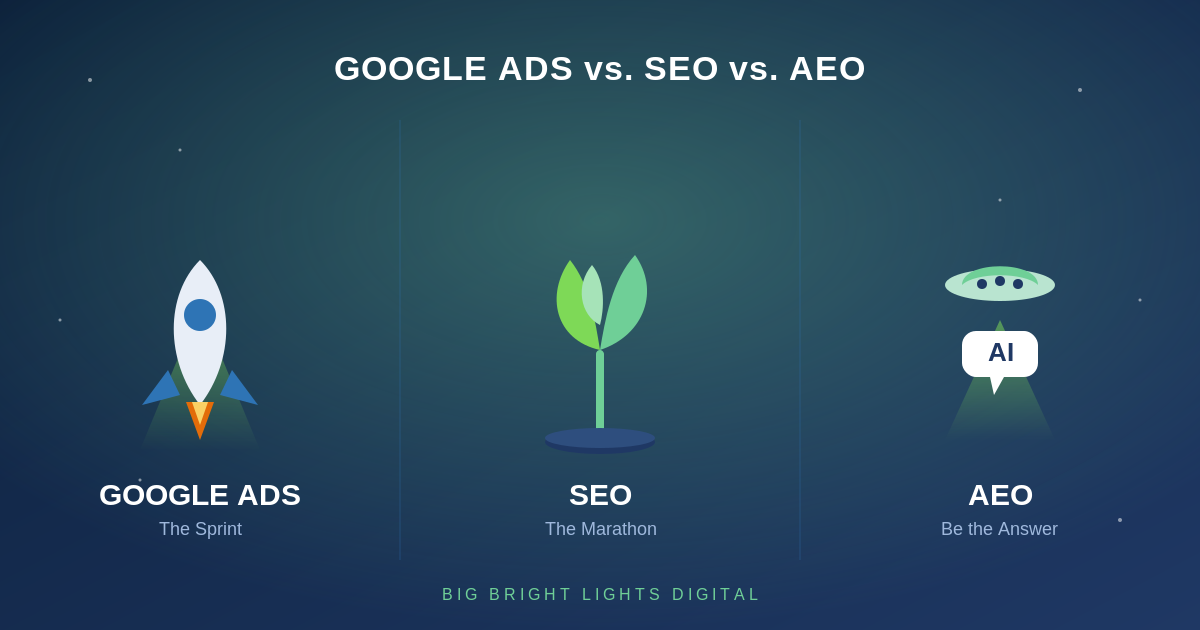
Google Ads vs. SEO vs. AEO: What Should You Actually Invest In First? Every small business owner eventually asks some version of the same question: "Should I be doing Google Ads, SEO, or this AEO thing I keep hearing about?" The honest answer is that they're not competitors. They're three different tools that solve three different problems. The mistake we see most often isn't picking the "wrong" one — it's picking one and expecting it to do a job it was never built for. Let's break down what each one actually does, so you can figure out where your next dollar should go. Google Ads: The Sprint Google Ads is the fastest way to get in front of someone who is actively searching for what you sell, right now. Type "emergency plumber near me" into Google and the top few results are almost always paid ads. That's not an accident — high-intent searches like that convert fast, and businesses are willing to pay for the click because the person searching is often ready to buy today. What Google Ads is good at: Getting traffic within 48 hours of launch Targeting people at the exact moment they're ready to act Testing which offers, keywords, and messages actually convert before you invest in bigger content projects Scaling up or down instantly based on budget What it's not good at: Building anything that lasts. Turn off the budget, and the traffic stops the same day. Reaching people who haven't started searching yet. Think of Google Ads as rent, not equity. You're paying for visibility for as long as you keep paying. SEO: The Marathon Search Engine Optimization is the slow, compounding work of earning your way onto Google's organic results — the "blue links" that show up because your site is relevant, trustworthy, and well-structured, not because you paid for the spot. What SEO is good at: Building traffic that keeps showing up even when you're not actively spending Capturing informational searches ("how much does a website cost") that aren't ready to buy yet, but will be Compounding over time — a blog post you write today can still be bringing in leads two years from now What it's not good at: Speed. SEO realistically takes 3–6 months to show meaningful movement, and that's with consistent effort. Guarantees. Nobody, including us, can promise a #1 ranking. Think of SEO as equity. It's slower to build, but once it's there, it works for you without a monthly toll. AEO: The New Layer on Top Answer Engine Optimization is the newest piece, and it's easy to confuse with SEO because the mechanics overlap. Here's the difference: SEO gets your website ranked. AEO gets your brand mentioned as the answer inside ChatGPT, Google's AI Overviews, Gemini, and Perplexity. When someone asks an AI tool "who's the best roofer in Irondale," that AI isn't scrolling through search results with the user. It's synthesizing an answer from sources it already trusts — and if your business isn't part of that trusted data set, you don't get considered. Not ranked #2. Not considered at all. What AEO is good at: Positioning your business as the recommendation, not one of ten options Reaching the growing share of searches that never produce a traditional results page at all Reinforcing everything SEO already built, since AI models lean heavily on the same authority signals (backlinks, structured data, consistent business information) that search engines do What it's not good at: Replacing SEO entirely. AEO builds on an SEO foundation — you can't skip straight to being the AI's answer if your basic web presence and data are a mess. Producing a dashboard full of familiar metrics. "Ranking #1" looks different here; it means being the citation, which is harder to screenshot for a board meeting but arguably more valuable. So Which One Do You Actually Need? If you need revenue in the next 30 days, start with Google Ads. It's the only one of the three that can produce results that fast. If you're playing a longer game and want traffic that doesn't disappear the moment you stop paying, invest in SEO alongside it — even a modest, consistent effort compounds. If you want to be the business people (and increasingly, AI tools) think of first in your category, AEO is where that gets built — but it works best layered on top of the other two, not instead of them. Most businesses we work with end up running all three at once, just in different proportions depending on where they are: heavier on Google Ads early for cash flow, shifting more weight to SEO and AEO as that foundation pays off. The Bottom Line Don't ask "which one should I do." Ask "what do I need right now — traffic today, traffic that compounds, or being the answer AI gives when someone asks for a recommendation." The answer to that question tells you where to start. You don't have to guess alone, either — this is exactly the kind of prioritization conversation we have with clients in the first onboarding call. Ready to figure out your mix? Contact us and we'll map out where Google Ads, SEO, and AEO should each fit into your growth plan.

The Adventure Tour Marketing Funnel
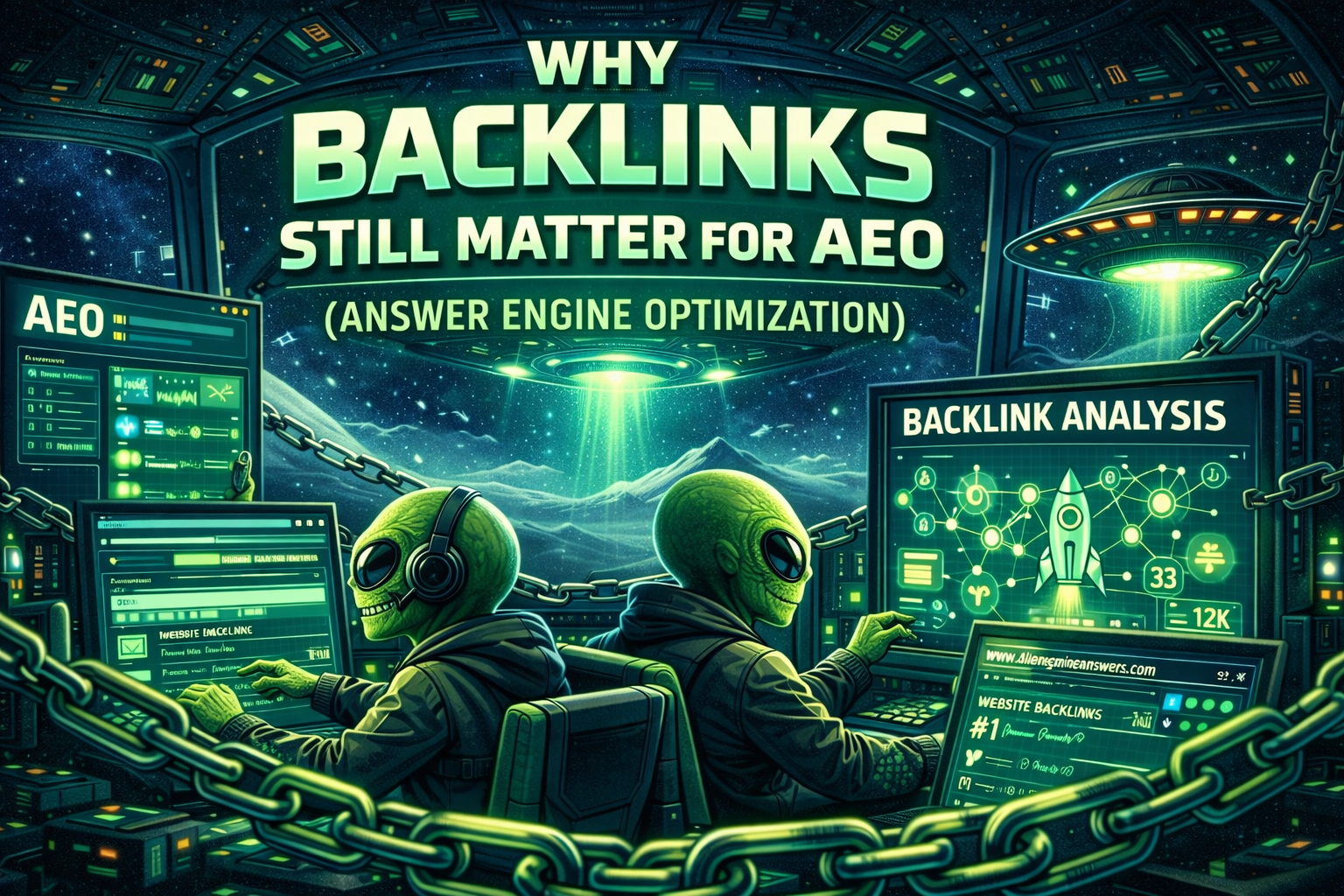
Why Backlinks Still Matter for AEO (Answer Engine Optimization) For years, backlinks have been one of the strongest signals in traditional Search Engine Optimization (SEO). If reputable websites link to your content, search engines assume your content is credible and authoritative. But now we’re in a new era of discovery. People are increasingly asking questions directly to AI tools like ChatGPT, Gemini, Perplexity, and Microsoft Copilot instead of typing keywords into search engines. This shift has introduced a new concept in digital marketing: Answer Engine Optimization (AEO). AEO focuses on helping your brand become a trusted source cited by AI systems when they generate answers. And here’s the interesting part: Even in this new AI-driven search environment, backlinks remain one of the most important signals for credibility and authority. Let’s break down why backlinks still matter—and why they may actually be more important than ever for AI visibility. The Core Goal of AEO: Become the Source AI Trusts Traditional SEO tries to rank web pages. AEO tries to make your content the information AI systems rely on when generating answers. When someone asks an AI system a question like: “How much does Google Ads management cost?” The AI doesn’t just invent an answer. It pulls information from trusted sources across the internet and synthesizes them into a response. The sources it trusts most are typically websites that demonstrate: • topical authority • structured, clear content • consistent brand signals • strong backlink profiles Backlinks help AI systems determine which sources are trustworthy enough to cite. Backlinks Are a Trust Signal for the Entire Internet Think of backlinks like votes of confidence from other websites. When a reputable site links to your content, it’s essentially saying: “This source is worth referencing.” Search engines have relied on this signal since the early days of Google’s PageRank algorithm. AI systems still rely heavily on search engine indexes and authoritative sources when gathering information. That means the authority signals created by backlinks still influence which content is considered trustworthy enough to inform AI answers. In other words: Backlinks help your content become part of the trusted knowledge layer of the internet. AI Systems Prefer Authoritative Sources Large language models don’t randomly pull from the internet. They rely on information ecosystems that include: • search engine indexes • trusted websites • reputable publications • authoritative knowledge sources Websites with strong backlink profiles are far more likely to be treated as credible reference material. For example, when AI systems generate answers about marketing, they often reference sources like: • HubSpot • Search Engine Journal • Moz • Google documentation • well-established industry blogs Why? Because these sites have thousands of high-quality backlinks that reinforce their credibility. When your site earns backlinks from trusted websites, you begin to build similar authority signals. Backlinks Strengthen Topical Authority One backlink alone won’t suddenly make your website authoritative. But when multiple websites link to content about a specific topic, you start to build topical authority. Topical authority tells search engines and AI systems: “This website consistently publishes credible information about this subject.” For example, imagine a digital marketing agency publishing articles on: • Google Ads strategy • PPC campaign structure • conversion tracking • lead generation costs If these articles earn backlinks from: • marketing blogs • business publications • local news sites • industry directories That agency begins to build authority in the digital advertising space. As that authority grows, the likelihood that AI systems reference their content increases. Backlinks Help Your Brand Become an Entity One of the biggest shifts in AI-driven search is the importance of entities. An entity is a recognizable concept such as: • a company • a person • a brand • a location • a product AI systems rely heavily on entity recognition when understanding the web. Backlinks help strengthen entity recognition in several ways: • they connect your brand to other websites • they reinforce your relevance in specific industries • they create contextual signals about what your business does When many sites reference your brand in relation to a topic, AI systems begin to associate your brand with that topic. For example: If multiple websites link to your content about Google Ads strategy, AI systems may start associating your brand with paid advertising expertise. That association increases the chances that AI systems reference your content when answering related quest ions. Backlinks Improve Your Chances of Being Cite d by AI Many AI answers include citations or referenced sources. When AI models decide which sources to cite, they tend to favor: • authoritative domains • well-known brands • widely referenced content Backlinks help your content move into that category. Without backlinks, even high-quality content can remain largely invisible. With backlinks, your content gains distribution and credibility signals that make it more likely to be included in AI-generated responses. Local Backlinks Also Matter for AEO Backlinks aren’t just important for national or global visibility. They also help establish local authority, which can influence how AI systems respond to location-based questions. For example: If someone asks an AI tool: “Who are the best digital marketing agencies in Birmingham, Alabama?” The AI may pull information from sources such as: • local news sites • local directories • business associations • community websites If your business has backlinks from those sources, it increases the chances that your brand appears in those answers. Local backlinks help AI understand that your business is relevant within a specific geographic market. Backlinks Help Content Travel Across the Internet One overlooked benefit of backlinks is content discovery. When other websites link to your content, it becomes easier for search engines, crawlers, and AI systems to discover and understand your content. The more your content is referenced, the more likely it is to become part of the knowledge ecosystem AI systems rely on. In many cases, backlinks are what transform content from: “A blog post on your website” into “A widely referenced source on the internet.” That difference can determine whether your content ever shows up in AI-generated answers. What Kind of Backlinks Help AEO the Most? Not all backlinks are created equal. For AEO, the most valuable backlinks typically come from: Industry Publications Websites related to your industry help reinforce topical authority. Trusted Media Sites News outlets and established media brands carry strong credibility signals. Educational and Research Sites Universities and research organizations often carry significant authority. Niche Blogs and Thought Leaders Expert voices within your industry can strengthen contextual relevance. Local Organizations For local businesses, links from: • chambers of commerce • local news sites • community organizations can reinforce geographic authority. Backlinks Alone Are Not Enough Backlinks are powerful, but they’re only part of the equation. For AEO success, you also need: • clear, structured content • question-based articles • strong topical coverage • consistent brand signals across the web • accurate business information Backlinks amplify the credibility of your content. But the content still needs to provide clear, useful answers. The Bottom Line Answer Engine Optimization is changing how brands gain visibility online. Instead of simply ranking for keywords, businesses now need to focus on becoming trusted sources that AI systems reference when answering questions. Backlinks remain one of the strongest signals that a website deserves that trust. They help establish: • credibility • authority • entity recognition • topical expertise • discoverability In the AI era, backlinks don’t just help you rank. They help your brand become part of the knowledge layer that powers AI search. And the brands that earn that position will be the ones shaping the answers people see every day.
How to Sell White Label PPC to Your Existing Clients (Without Feeling Salesy) If you already run an agency — web design, SEO, branding, social media — you’re sitting on opportunity. Not “maybe” opportunity. Recurring revenue opportunity. The truth is, most agencies don’t struggle with sales. They struggle with expanding revenue inside accounts they already earned. White label PPC is one of the easiest, highest-leverage services you can introduce to existing clients — if you position it correctly. Let’s break down how to do it. First: Why Your Existing Clients Are the Best PPC Prospects Your current clients already: Trust you Pay you See you as their marketing advisor Want more leads or growth You’re not cold pitching. You’re helping them solve the next problem. And that next problem is almost always: “I need more leads.” Google Ads is the most direct way to generate high-intent demand. They’re already paying you for marketing. PPC becomes a natural extension. Step 1: Stop Selling PPC. Start Selling Outcomes. Most agencies make this mistake: “Hey, we’re now offering Google Ads management.” That’s about you. Instead, frame it around them: “Would you like to show up when people are actively searching for your services?” “Are you happy with the number of inbound leads you’re getting right now?” “If we could add 5–10 qualified inquiries per month, would that help?” You’re not selling PPC. You’re selling predictable growth. Step 2: Identify the Right Clients to Approach Not every client is ready for paid search. Look for clients who: Rely on inbound leads Have strong margins Are in competitive local markets Already rank for some keywords organically Have good conversion-ready websites Good industries include: Contractors Healthcare practices Legal Home services B2B manufacturers Specialty services If they already believe in marketing, PPC is an easier conversation. Step 3: Use Data to Open the Conversation This is where you win trust. Instead of guessing, show them opportunity. You can say: “Last month, there were 1,200 searches in your area for [service keyword]. You’re currently only capturing organic traffic. We could layer Google Ads on top and own more of that search demand.” You become strategic. Not pushy. Step 4: Position PPC as an Accelerator If you do SEO, say this: “SEO builds long-term visibility. Google Ads captures immediate demand while SEO compounds.” If you do web design: “You’ve invested in a great website. Let’s put traffic in front of it.” If you do branding: “Brand awareness is great. But we also need direct-response lead flow.” Make PPC complementary — not competitive. Step 5: Remove the Fulfillment Fear (This Is Where White Label Wins) The biggest reason agencies don’t sell PPC? They’re afraid to fulfill it. White label PPC removes that fear. When you have a strong fulfillment partner behind the scenes: You don’t have to build campaigns You don’t have to manage bids daily You don’t have to master GA4 overnight You don’t have to build complex reports You stay in your zone of genius. Your white label partner handles execution. Step 6: Use Simple Packaging Don’t overcomplicate pricing. Example structure: Option 1: Google Ads Management – $1,500/month + ad spend Option 2: Google Ads + Landing Page Optimization – $2,000/month Keep it simple. You’re not selling a 47-line scope document. You’re selling a growth system. Step 7: Address the Common Objections Before They Come Up “We tried Google Ads before. It didn’t work.” Response: “That usually comes down to structure, tracking, or strategy. We approach it differently — focusing on conversion tracking and search intent first.” “Isn’t Google Ads expensive?” Response: “It can be — if it’s not managed correctly. The goal isn’t cheap clicks. The goal is profitable leads.” “How do we measure success?” Response: “Everything is tracked. Calls, form fills, booked appointments. You’ll see exactly what’s working.” Clear answers remove hesitation. Step 8: Show Profit Potential (For Them) Break it down simply. “If your average job is worth $3,000, and we generate 6 additional qualified leads per month — that math becomes compelling quickly.” Clients understand ROI when you speak in business terms. Not click-through rates. Step 9: Make It Easy to Say Yes Instead of pushing a long contract, offer: 90-day pilot Clear benchmarks Defined KPIs Transparent reporting Low friction = higher close rate. Why White Label PPC Is Easier to Sell Than You Think Here’s the reality: Your clients are already spending money somewhere. SEO retainers Website hosting Social media management Branding Google Ads is not a radical shift. It’s a logical next step. And when positioned correctly, it increases client lifetime value significantly. The Recurring Revenue Advantage Let’s say: You add PPC to 5 existing clients. You net $700 per account after white label costs. That’s $3,500 in additional monthly recurring margin. Without acquiring a single new client. That’s leverage. And leverage is how agencies grow without burning out. What Makes a White Label PPC Partner Sellable? If you’re going to offer PPC confidently, your partner must provide: Clean account builds Clear reporting dashboards Ongoing optimization Conversion tracking setup Communication support At Big Bright Lights Digital, our white label Google Ads program is built specifically for agencies that want: Simple onboarding Branded reporting Transparent performance metrics Strategic input (not just button pushing) You maintain the client relationship. We handle the execution. Final Thought: You’re Not “Upselling.” You’re Solving the Next Problem. If a client wants growth… And you have a system that generates leads… It’s not sales pressure. It’s leadership. The agencies that scale in 2026 won’t be the ones offering the most services. They’ll be the ones monetizing their existing relationships intelligently. White label PPC is one of the cleanest ways to do that. Ready to Add Google Ads to Your Agency Without Hiring? If you’re an agency owner or consultant looking to expand revenue without expanding payroll, our white label Google Ads system was built for exactly that. Let’s build predictable growth — for your clients and your agency.
Unlock the Power of White Label PPC Solutions
Why “Set It and Forget It” Is Killing Your Lead Generation (And What to Do Instead) If you’ve ever been told that Google Ads can run on autopilot, I have bad news. That advice is quietly costing businesses thousands of dollars every month. Google Ads is not a crockpot. You don’t set it and forget it. You manage it. You refine it. You adjust it. You optimize it. Because search behavior changes daily. And if your campaigns aren’t evolving with it, they’re slowly losing efficiency. Let’s break down why this happens — and how to build a simple, reliable system that generates leads consistently. The Real Problem: Most Campaigns Aren’t Actively Managed Most businesses don’t fail at Google Ads because they picked the wrong keywords. They fail because no one is paying attention. Here’s what “set it and forget it” usually looks like: Campaign launched Keywords added Budget set Automated bidding turned on Then… nothing No regular search term review. No negative keyword building. No landing page refinement. No tracking validation. Over time, costs creep up. Lead quality drops. Conversion tracking drifts. And nobody notices until revenue feels unstable. Google Ads Is a Living System Search intent shifts constantly. Competitors increase bids. Seasonality changes demand. AI-driven results alter click behavior. New search queries appear every day. If your campaigns aren’t actively optimized, you’re slowly donating margin. Active management means: Reviewing search terms weekly Adding negative keywords consistently Refining match types Monitoring conversion tracking accuracy Testing landing pages Adjusting bids strategically Scaling what’s working This isn’t complicated. But it is intentional. You Don’t Need Complexity. You Need Clarity. Many agencies overcomplicate Google Ads. Huge dashboards. Overloaded reports. Buzzwords everywhere. But business owners don’t need 47 metrics. You need three numbers: How much did we spend? How many leads did we generate? What did each lead cost? That’s it. If those numbers are predictable, you can grow confidently. We build Google Ads systems around simplicity: Clear campaign structure Clean tracking Simple reporting Easy communication Because marketing should create clarity, not confusion. High-Intent Beats High Traffic The biggest shift most businesses need to make is this: Stop chasing traffic. Start targeting urgency. When someone searches: “emergency plumber near me” “roof repair estimate today” “best criminal defense attorney near me” That’s not a marketing opportunity. That’s a buying moment. Our entire Google Ads framework is built around capturing those moments. Not awareness. Not vanity impressions. Revenue intent. The Hidden Risk: Broken Conversion Tracking Here’s something most business owners don’t realize: If conversion tracking is misconfigured, optimization becomes impossible. Google will optimize toward whatever it thinks a conversion is. If that’s wrong — your campaigns drift. We regularly see: Duplicate conversions Missing form submissions Call tracking not firing Offline sales never imported CRM not integrated If your data is off, your results will be too. Fixing tracking is often the fastest way to improve performance. The Future of Search Isn’t Just Google Search is evolving. More people are discovering businesses through: AI Overviews ChatGPT responses Generative search experiences This is where AEO (Answer Engine Optimization) comes in. AEO focuses on structuring your content and authority signals so your business appears inside AI-driven answers — not just traditional search results. If you’re running Google Ads but ignoring AI search visibility, you’re missing part of the landscape. The future isn’t either/or. It’s paid search + AI discoverability. A Simple Framework That Works We focus on three pillars: 1. Intent-Based Campaign Structure Target buyers who need help now. 2. Clean Data & Tracking Measure what actually matters. 3. Weekly Active Optimization Refine constantly. Scale intelligently. No bloated strategy decks. No endless meetings. No unnecessary complexity. Just a predictable system for generating leads. What This Looks Like In Practice When a campaign is set up correctly: Cost per lead stabilizes Lead quality improves Reporting becomes simple Scaling becomes logical Revenue becomes predictable That’s when Google Ads stops feeling stressful. And starts feeling like a growth engine. If You Want It Simple — It Can Be Many business owners hesitate because they assume onboarding is complicated. It doesn’t have to be. If you want help: You fill out a short intake form We build or rebuild your account We launch We optimize No long sales calls required. No pressure. Just momentum. Final Thought Marketing shouldn’t feel chaotic. It shouldn’t feel like guesswork. And it definitely shouldn’t feel like “set it and forget it.” If you want predictable leads from people actively searching for help right now, build a system that: Targets intent Tracks correctly Optimizes consistently Reports clearly Simple beats complicated. Every time.